

(This post contains affiliate links.)
I have a little book club of Catholic women, mostly moms, and we take turns choosing the books. The taking turns was a concession, because let’s be real. I started the book club so all my friends would read my favorite books and then we could yap about them over wine. I’m a simple girl. But having a monopoly on the choices was simple vanity because I was just so unsure what kind of books the other women liked and I trust mostly my own taste. That is my confession. (Absolution may not be possible, because I am not sure about true contrition.)
However, the ladies in the club have chosen some very fine books that I have thoroughly enjoyed! It has been a pleasure to expand my library, with the exception of one book which we read a year ago. This book has 4.8 stars on Amazon. Five stars on Tan. I keep seeing Catholic women (and men!) online singing its praises. And yet, the issues I have with this book could be a whole new book.
The book is The Anti-Mary Exposed by Carrie Gress.
I want to preface this criticism with this clear statement: I am not a feminist. I’m not a first wave feminist. I’m not a Catholic feminist. I’m not a feminist at all. I embrace very traditional and intuitive notions of femininity and masculinity. I would trade my right to vote and hold property if I could save my daughters from being subject against their wills to a 40-hour work week. My perfect days are at home, barefoot in my sundress, making concoctions in the kitchen, and yapping with my husband. I have more kids than average (is the number really currently 11???) and I’m in my 19th year of homeschooling. Evidence would lead one to conclude I am a classically feminine woman. So unlike the 11 people on Amazon who gave this book a one-star review, I don’t dislike this book because I am some sort of secret feminist, nor do I think this book is trying to oppress by or enslave women to the perceived patriarchy.
When I picked up this book, I expected to enjoy it, based on the high praises of people I respect on the internet. Immediately I started making notes in the margin to bring up at book club. Were we all seeing the same flaws in logic, misquotations, presumption, generalizations, misandry, and even heresy? Surely I was not alone.
When I finished reading it I passed this book to a friend who has strong literary opinions, a solid Catholic theological foundation, and is classically feminine. She read it and added to the notes in the margin. She passed the book to her husband. He added his notes to the margins. Finally others saw the things I saw and then some! With pages filled with rebuttals, citations, and more questions than answers to the bizarre conclusions asserted by the author I returned the book to my bookshelf and forgot about it. Until at least three times in the past two weeks it has again been praised in my social media feed. So, I decided to dust it off and write up a little critique.
The issues with this book are too numerous for a blog post. Almost every page has notes on top of notes with everything from misquoting Scripture and the Church Fathers to missing citations for quotes and ideas not belonging to the author, to things laugh-out-loud funny that should have been caught in the first draft edit. (For example, page 119 claims that The Blessed Virgin Mary is the most painted and photographed person in human history. Photographed???)
For the sake of this blog post, which is already long enough, I’m going to limit my criticism to a deep theological misreading of Scripture that can lead to heresy.
In chapter one the author bestows on Mary a new title (which is already shaky ground, because who does that?). “First we know that Our Lady brings a unique spirit into the world as the Mother of God. She is the anti-Eve.” This title casts Mary as the hero and Eve the villain. The author doubles down on this in chapter 3 making the bold claim that “Scripture makes it clear that there is a type of woman who needs to be avoided, whose influence will always lead to bad places. Eve is certainly the prime example, with Jezebel, Herodias, and the Whore of Babylon as other standouts.” (Emphasis mine)
To understand how much this premise bothers me, you must understand a traditional title of Our Lady: Queen of all Saints, one of the final invocations in the Litany of Loredo. This is a prime example of the concept that if you get your mariology wrong your christology will also fall apart.
In the Catholic calendar of Saints there are a few beacons that have been there since the beginning, first-round-drafts for eternity if you will. These powerful intercessors stand as a faithful witness throughout the generations showing us the way to heaven. These saints demonstrate for us true penance and proclaim that healing and redemptions is possible. As the saying goes, “there is no saint without a past and no sinner without a future.” (Most people attribute this to St. Augustine, but most likely belongs to Oscar Wilde.) The OGs on that calendar are none other than Saints Adam and Eve, our first parents.
In an ancient homily for Holy Saturday quoted in the Catechism (CCC 635) it is written “Today a great silence reigns on earth, a great silence and a great stillness. A great silence because the King is asleep. the earth trembled and is still because God has fallen asleep in the flesh and he has raised up all who have slept ever since the world began. . . He has gone to search for Adam, our first father, as for a lost sheep. Greatly desiring to visit those who live in darkness and in the shadow of death, he has gone to free from sorrow Adam in his bonds and Eve, captive with him – He who is both their God and the son of Eve. . . “I am your God, who for your sake have become your son. . . I order you, O sleeper, to awake. I did not create you to be a prisoner in hell. Rise from the dead, for I am the life of the dead.”
Jesus is called the Son of Eve.
The idea that after the crucifixion Christ descended to the place of the dead and raised up those awaiting redemption is declared in our Creed every time we pray. This doctrine has been written in countless icons across Christendom from ancient times until now. The most notable is the Harrowing of Hell. In it we can see Jesus reaching his hands out to Adam and Eve in the graves and drawing them to himself, completing his work of redemption in their lives (and thereby ours!).
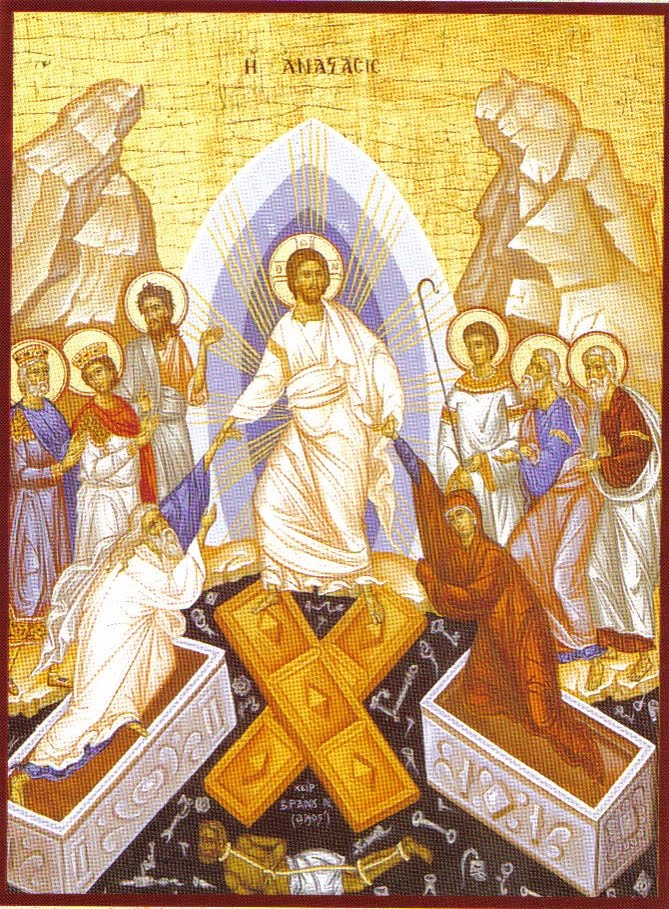
The idea that Adam and Eve lived and died as pious penitents is one of the most ancient concepts of our faith and their lives and sainthood inspire us to repentance and holy living, while comforting us that no matter what we have done, healing is possible.
This being such an integral part of our deposit of faith (the very concept on which hangs our very own redemption) why does the author list Eve amongst the damned and call her an example to always be avoided when the Church Fathers called Jesus her Son? She is an example to be imitated, a saint, our first mother, and model of penitential living and holy death. She is honored among the saints and her Queen is Mary herself–Queen of all Saints.
Therefore when the author of this book calls Mary the anti-Eve she casts a dark shadow on the hope of our own redemption and her Divine Son’s ability to save. I will reiterate, when we get our mariology wrong we lose our christology in the bargain.
The New Eve
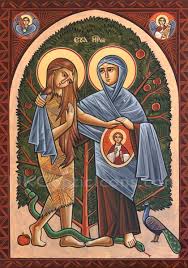
So far from being the opposition of Eve, the Church gives Mary the very name Eve. She is called the New Eve. This link between Mary and Eve is so strong (and so positive) that we can reach back to St. Justin Martyr in the year 150 for his writings on Eve in Dialogue with Trypho.
Thirty years later St. Irenaeus wrote Against Heresies and declares, “And thus also it was that the knot of Eve’s disobedience was loosed by the obedience of Mary. For what the virgin Eve had bound fast through unbelief, this did the virgin Mary set free through faith.”
This understanding of Mary as the new Eve is so important to our faith it protects us against heresies. Thank you, St. Irenaeus.
In conclusion I cannot dissuade you from reading The Anti-Mary Exposed hard enough. If you want to talk about other objections, I am happy to expound. Drop me a comment. If you are looking for a book that will help you to reclaim your femininity in a culture toxic to it, please read any of our women saints: St. Hildegard, St. Therese, Edith Stein, and on and on. There are so many inspiring women to recommend so whole-heartedly that this book doesn’t deserve a place on your bookshelf.
Here are some book recommendations for women by women that may very well inspire your feminine soul:
Harlots of the Desert: A Study of Repentance in Early Monastic Sources by Benedicta Ward
The Eternal Woman: The Timeless Meaning of the Feminine by Gertrud von le Fort
Bogoroditza : She Who Gave Birth to God by Catherine de Hueck Doherty
Saint Eve, our first mother and saint, ora pro nobis.
Holy Mary, Queen of all saints, ora pro nobis.
Blessed be God in his Angels and in his Saints
 reconciling things