
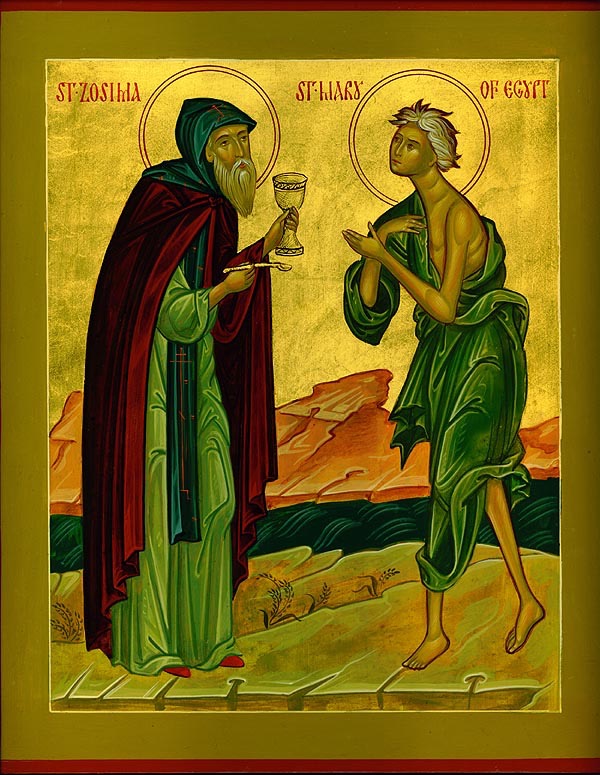
What we know about St. Mary of Egypt comes from oral tradition, recorded by St. Sophronius. And though the facts seem fantastical, it is one of the truest stories in Christendom. It is beautiful, nuanced, rich, and shocking to the point of being sensational. Yet it is transcendent in that it is true, good, and beautiful.
Mary was born around the year 344 in Egypt. When she was 12 years old she fled to Alexandria and began a life of prostitution. And while she could adequately support herself in this way, sometimes she gave out sexual favors for free because she was insatiable. So, she supplemented her sex-work with spinning flax. Yes, you read that right. She didn’t supplement her spinning with prostitution. She supplemented her prostitution with spinning. For seventeen years she was the city’s premier public prostitute.
After 17 years she decided on a whim to join a pilgrimage to the Holy Land for the Feast of the Exaltation of the Holy Cross. She was not religious in the slightest, but went along in order to seduce the pilgrims. When she arrived in Jerusalem she attempted to enter the Church of the Holy Seplechre for the great feast. But an invisible presence would not allow her to enter the church. She was repelled back. She tried multiple times to enter the church. Finally, defeated, she retired to a corner of the churchyard and was given the grace of true repentance. There she wept allowed for her sins and wickedness. Then her eyes fell upon the icon of the Theotokos. She prayed for forgiveness and promised to give up the world.
After she finished weeping she got up and attempted to enter the church again. This time she was allowed to enter. There she venerated the relic of the True Cross. She returned to the icon of Our Lady and gave thanks. Suddenly she heard a voice telling her “If you cross the Jordan, you will find glorious rest/true peace.” She went immediately to the monastery of St. John the Baptist (the OG Christian ascetic), made a worthy confession, received absolution, and Holy Communion.
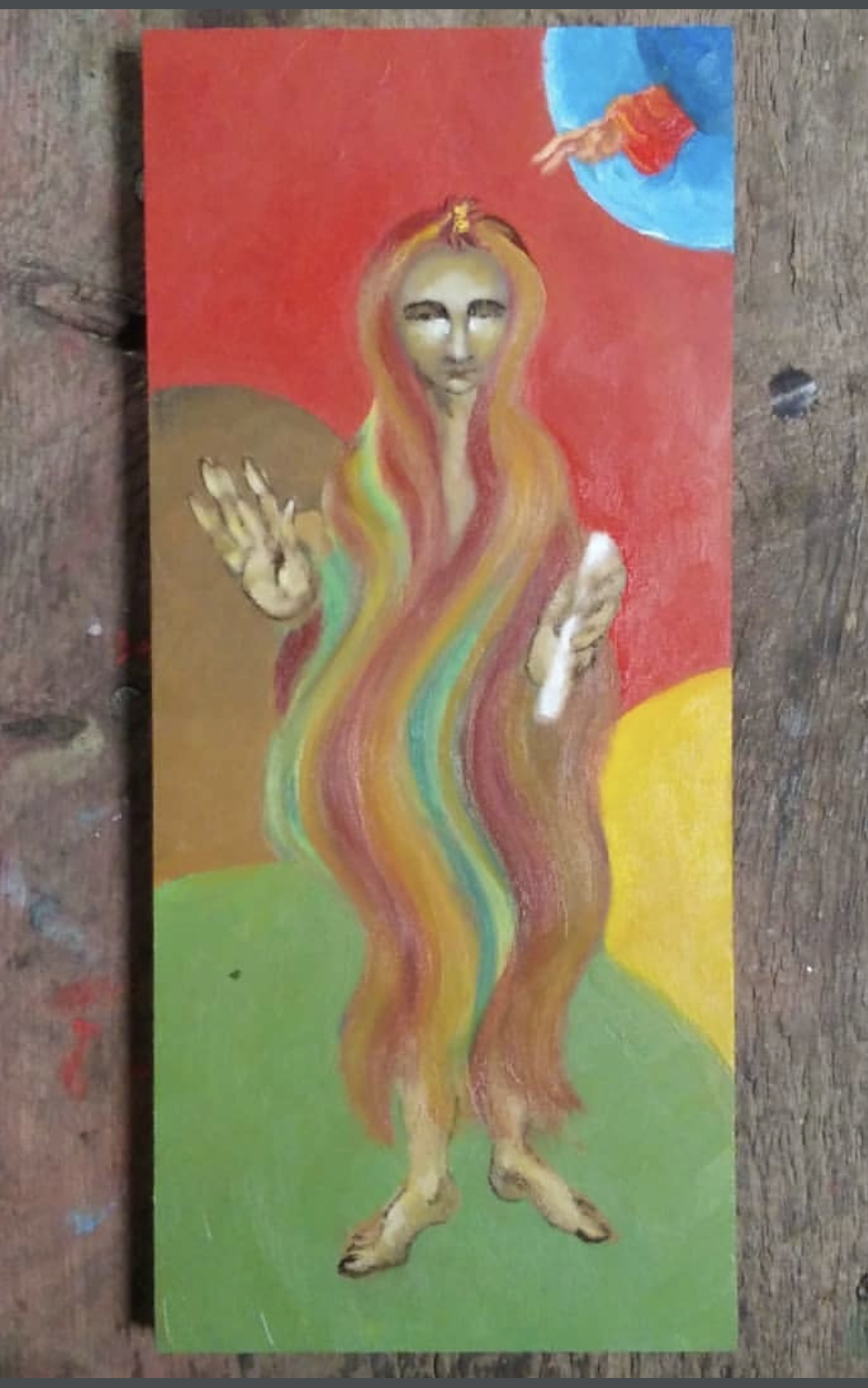
The next morning she crossed the Jordan to live the rest of her life as a hermit. She took with her only three loaves of bread. When they were gone she lived off whatever she could find in the wilderness for the next 47 years. This isn’t the end of the story for the harlot turned Desert Mother. If it was, maybe we would not have this account of her life.
About a year before her death (approximately 421) she encountered St. Zosimas in the desert on the banks of the Jordan. He was making a Lenten fast in the desert as was the custom of ascetics. When she saw him, she called him by name, although they had never met previously, and recognized him as a priest.
When he found her she was completely naked and looked otherworldly. She covered herself with her wild hair. Zosimas provided her his mantle to cover herself as they talked. She told her life story to him. He was astounded by her wisdom and insight. Afterward she asked him to bring her Holy Communion on the following year’s Holy Thursday. The next year on Holy Thursday the great saint journeyed back to the Jordan with the Eucharist. There he found her lying dead on the banks. Before she died she had written in the sand requesting Christian burial, indicating that she had died the very night she had received Communion from him. Her body was preserved and incorrupt.
But wait……there’s more…..
St. Zosimas buried her in the desert with the help of a passing lion. Yes, an actual lion. He returned to the monastery and told of her virtue and death to the brothers there. This story was preserved by oral tradition and written down by St. Sophronius, the Patriarch of Jerusalem, 200 years later.
When I first told this story to a new convert he laughed and told me how ridiculous it was. “You cannot possibly believe that actually happened!” he said. I maintained the story was absolutely true. He said, “So, it’s factual?” and I replied, “That is neither here nor there. It is true. Absolutely. And also good and beautiful.”
And that’s the real thing that modern man (or post-modern man, shall we say) has to grapple with: the meaning of truth.
I think the reason we cannot distinguish between truth and lies is because we insist on parsing facts and truth, pitting them against each other. We make earth judge heaven and not heaven earth as Chesterton puts it. We think that if we cannot point a camera at something and verify the story that it isn’t true. Never mind that if our current event footage and news cycle has shown us anything it is that we shouldn’t put the weight of something as human as perception on something as inhumane as technology. Everyone person walks around with a camera and computer in their pocket and yet mankind is no closer to laying hold of the truth of a traffic accident let alone the meaning of the world.
Maybe it’s time we return to true stories and abide by the ethics of elfland. In his essay, “The Ethics of Elfland” Chesterton writes, “The man who quotes some German historian against the tradition of the Catholic Church, for instance, is strictly appealing to aristocracy. He is appealing to the superiority of one expert against the awful authority of a mob. It is quite easy to see why a legend is treated, and ought to be treated, more respectfully than a book of history. The legend is generally made by the majority of people in the village, who are sane. The book is generally written by the one man in the village who is mad.“
The true story of St. Mary of Egypt shows us the power of repentance to restore virtue to something more glorious than one can imagine, even greater than it was before the lost virtue. The life of St. Mary demonstrates the power of faith, of grace, of the Eucharist himself. Her life shows us that truly anything is possible and that it is in the losing yourself that the whole of the Kingdom is obtained. It is the Felix Culpa in action.
“But I deal here with what ethic and philosophy come from being fed on fairy tales. If I were describing them in detail I could note many noble and healthy principles that arise from them. There is the chivalrous lesson of “Jack the Giant Killer”; that giants should be killed because they are gigantic. It is a manly mutiny against pride as such. For the rebel is older than all the kingdoms, and the Jacobin has more tradition than the Jacobite. There is the lesson of “Cinderella,” which is the same as that of the Magnificat—EXALTAVIT HUMILES. There is the great lesson of “Beauty and the Beast”; that a thing must be loved BEFORE it is loveable. There is the terrible allegory of the “Sleeping Beauty,” which tells how the human creature was blessed with all birthday gifts, yet cursed with death; and how death also may perhaps be softened to a sleep. But I am not concerned with any of the separate statutes of elfand, but with the whole spirit of its law, which I learnt before I could speak, and shall retain when I cannot write. I am concerned with a certain way of looking at life, which was created in me by the fairy tales, but has since been meekly ratified by the mere facts….
“Remember, however, that to be breakable is not the same as to be perishable. Strike a glass, and it will not endure an instant; simply do not strike it, and it will endure a thousand years. Such, it seemed, was the joy of man, either in elfland or on earth; the happiness depended on NOT DOING SOMETHING which you could at any moment do and which, very often, it was not obvious why you should not do. Now, the point here is that to ME this did not seem unjust. If the miller’s third son said to the fairy, “Explain why I must not stand on my head in the fairy palace,” the other might fairly reply, “Well, if it comes to that, explain the fairy palace.” If Cinderella says, “How is it that I must leave the ball at twelve?” her godmother might answer, “How is it that you are going there till twelve?” If I leave a man in my will ten talking elephants and a hundred winged horses, he cannot complain if the conditions partake of the slight eccentricity of the gift. He must not look a winged horse in the mouth. And it seemed to me that existence was itself so very eccentric a legacy that I could not complain of not understanding the limitations of the vision when I did not understand the vision they limited. The frame was no stranger than the picture. The veto might well be as wild as the vision; it might be as startling as the sun, as elusive as the waters, as fantastic and terrible as the towering trees.” (GK Chesterton, The Ethics of Elfland)
One might say of St. Mary’s life, “explain how she survived 47 years on nothing substantial!” but skip over the question of “Why would a beautiful woman want to retire to the wilderness and do nothing but offer her life to God?”
One might say, “explain how a lion helped bury her body!” but skip the fact that she lived among lions unharmed.
One might say, “explain how St. Zosimas could find her again!” but miss the question of how is it that he carried Jesus Himself into the desert.
Which is why I’ve always said I’d rather be a mystic than a theologian.
 reconciling things