
I don’t know if there will be a part two. The rest of this talk may only exist in voice memos to my best friend and rants in the car with my husband. Because quite frankly, I think a lot of Catholic content creators on the internet have lost the plot.
But I will begin with the response to my last post of “Women of a Certain Age.” To sum up, that post was about perimenopause and how I am learning to grieve the loss of my fertility and still embrace the other physical and spiritual manifestations of my femininity. Although I try to be a pretty clear communicator, obviously I missed the mark because people have misunderstood. Comments on my socials very kindly tried to comfort me with advice to deal with the physical symptoms of perimenopause or reasons behind menopausal weight gain or with the fact that once I have grandkids I won’t worry about my own fertility or that once I hit menopause my libido will be long gone along with the hormonal unpredictability.
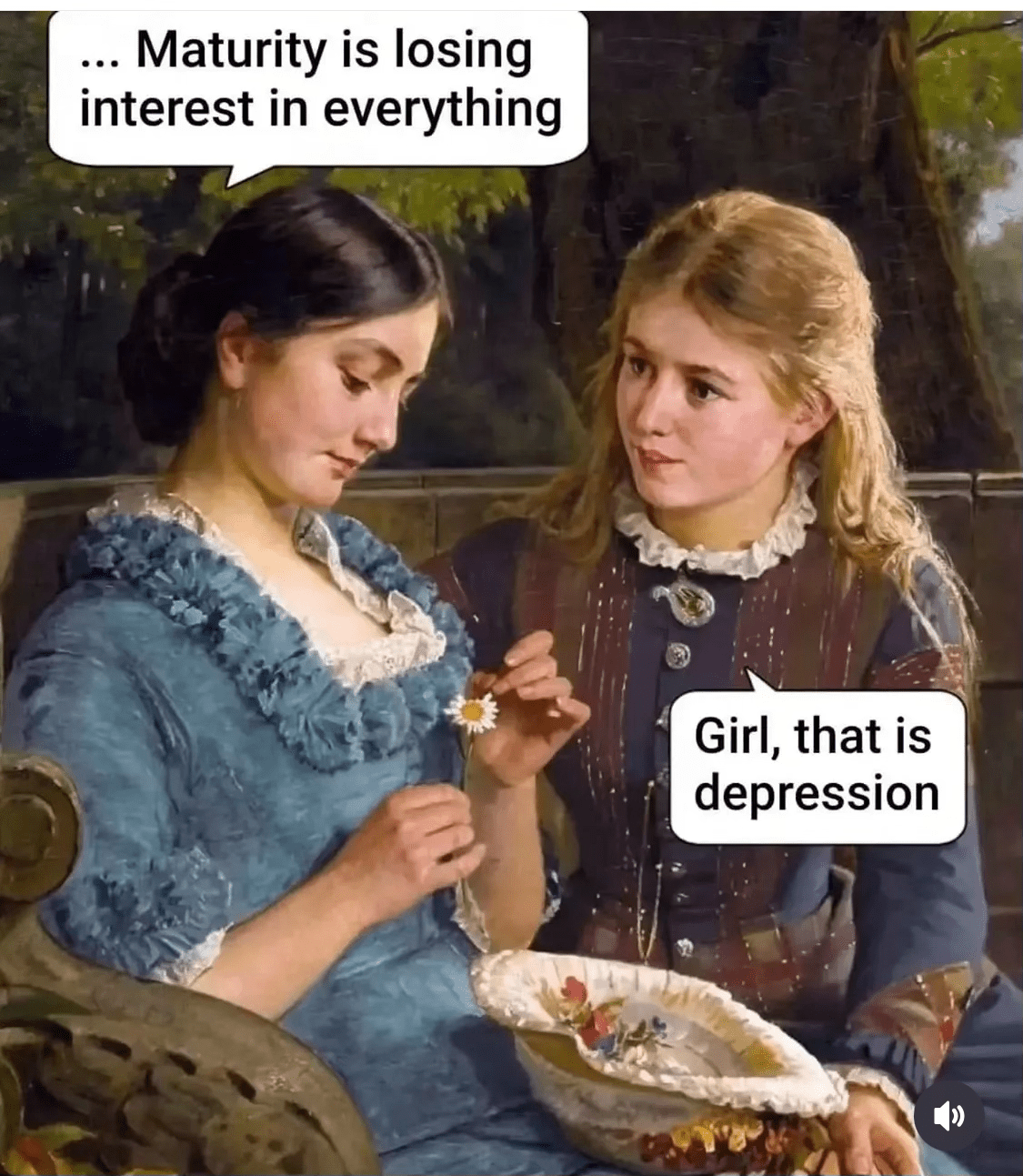
Now, pour yourself a cup of tea or a shot of vodka, because I’m going to make a bold statement. If you are not hungry, happy, and horny, you are not healthy. Sorry, not sorry. These are natural God-given drives that are indicators of what is going on in your cells and in your soul. Lack of desire is not maturity; it’s depression, honey.
People mistaking indifference for virtue is all too common. I think that is why many would rather depict dear chaste St. Joseph as old and infirm rather than young and virile. Sometimes it is easier for us to think of him as chaste if we pair that with too old to have drives. But that isn’t virtue. Understanding that he was likely young and in the prime of life and yet had the self-mastery, courage, and purity to bring his desires under control–that is virtue! That’s the stuff of saints!
Take a second shot of vodka or a stronger cup of tea, because my second claim is this: I think a strong Scriptural case can be made for recreational sex into your golden years. (I did not say extra-marital or pre-marital. I said recreational. So make sure you note that.) Don’t worry. I shall bring receipts.
The Biblical Accounts
Proverbs 5:18-19 warns against impurity. The wise one admonishes another to, “rejoice in the wife of your youth, a lovely deer, a graceful doe. May her breasts satisfy you at all times; may you be intoxicated always by her love.” At all times and always. Even when those breasts have nursed 9 children and resemble tube socks. (Roll ’em up and tuck ’em in, ladies.)
Let’s look at this actually lived out in the lives of the patriarchs and saints, shall we? God appears to Abraham in Genesis 18. He tells Abraham, by this time an old man with an old wife, that they will have a son. Sarah laughs. She does not believe the message. We must establish her unbelief. Because if she believed then their marital intimacy would have the goal of procreation. She says, “After I have grown old, and my husband is old, shall I be fruitful?” (v12) Scripture clearly says she doesn’t believe and God calls her out on that. “The Lord said to Abraham, “Why did Sarah laugh and say, ‘ShallI indeed bear a child, now that I am old?’ Is anything too wonderful for the Lord? At the set time I will return to you, in due season, and Sarah shall have a son.” But Sarah denied, saying, “I did not laugh,” for she was afraid. He said, “Yes, you did laugh.” (v13-15) However, three chapters later she gives birth to Isaac. By this we can gather the following, Sarah did not believe she was fertile at all, yet they were still having normal marital relations even in their old age. They did not have intimacy in order to procreate. In this instance the sexual act was primarily unitive. God is the one who made their love-making life-giving.
Let’s look also at St. Zechariah and St. Elizabeth. They were old and they were barren. St. Zechariah was a priest of the Lord. He goes into the holy place and encounters God. God tells him that he will have a son. Zechariah does not believe. Because of his unbelief he is struck mute. The Angel of the Lord tells him that he will not be able to utter a word until everything is fulfilled.
Can you imagine this? He leaves the temple, goes home to his old barren wife, and he’s unable to speak? He can’t even tell her what the Angel said. The sadness and confusion must have been pretty intense. So what do they do? They comfort each other with their bodies. They did not remotely believe they were having procreational sex. They were having unitive sex. And God worked a miracle through that love. (If ever there were an excuse for Sunday afternoon delight, I guess you can use this story.)

The Catechism
Somehow the algorithm decided after my post on menopause that it needed to show me Catholic content creators talking about sex. Something I have never looked up a day in my life because I have my Bible, my catechism, my husband, and my conscience. I honestly never thought to ask Susan from the Parish Council who suddenly fancies herself an influencer her opinion on whether my marriage bed was undefiled. To hear these people tell it, sex is primarily procreative and the unitive aspect is secondary or just happens as a matter of course. The Catechism addressed the calling to chastity in CCC2351.
“Sexual pleasure is morally disordered when sought for itself, isolated from its procreative and unitive purposes.” CCC2351
Within that definition there is a lot of room for joy and expression, provided you don’t practice contraception. There is a difference between being open to life (what we are all called to as married Christians) and ensuring that every sexual encounter optimizes likelihood of conception. Holy married joy can be its own objective. One of my priests has said, “One expression of the transformation made possible in Christ is an increased capacity for joy.”
The twofold end of marriage, according to the catechism is: the good of the spouses themselves and the transmission of life. (CCC2363) These two values cannot be separated without altering the couple’s spiritual life and compromising the good of the marriage.
While, “The conjugal love of man and woman thus stands under the twofold obligation of fidelity and fecundity” I would propose that you can have God-honoring sex that is unitive but not procreative, while still being open to life (see the example of the patriarchs) but you cannot have God-honoring sex that is fecund, but non-unitive. In other words, if you have sex that is procreative, but it lacks love, compassion, and the pleasure of both partners, it’s missing the mark completely. This could actually be gravely sinful. Check your conscience. Go to confession.
Which is why I take issue with anyone who says that any orgasm of either partner that happens without penis in vagina or that involves other means of stimulation is mortally sinful. (I have seen those claims many times.) Because most women will not be able to achieve their first climax (of many that are possible) on immediate penetration. And as a man, if your goal is not give your wife as much pleasure as possible, you need to repent. “…the truly human performance of these acts fosters the self-giving they signify and enriches the spouses in joy and gratitude. Sexuality is a source of joy and pleasure.” CCC2362
Storytime
I once crawled into bed with my grandma when I was a teenager and she was in her 80s. We often cuddled in the early mornings and talked in low voices. She was my confidant. While I was laying next to her, my grandfather who was a little deaf at this point, didn’t know I had come into the room. He reached for my grandma and said, “Come here, Martha. Let me play with your titties.” I died. My grandma and I laughed until we cried. And I fled the room as quickly as possible.
Although hilarious and embarrassing for a teenager, I am also so proud of them that they were still enjoying each other–“til death do us part.” That’s goals, man.
Of course desires wane. Just like we all don’t eat like we did when we were growing teenagers, our desire for sex is also not the same as when we were coming of age. But should we just accept as a matter of course that either desire disappear completely unless we are near death?
Therefore…
In conclusion (because I don’t know if I am brave enough to talk in more specifics unless I also take a shot or two of vodka and it’s 8am.) turn to your Bible, your catechism, and your spouse. Turn off the “experts” on TikTok or Instagram. You are the expert on how best to please your spouse and your spouse is the expert on how to please you. And if that is not true, start communicating and maybe experimenting. Express joy with each other and not just procreation. Because they really have to go together.
And if you are single, divorced, widowed, or just old remember that you still have a sex drive. And that gives you something to offer to the Lord and means by which you can be sanctified. You don’t have to deny the existence of the drive to happy. (Just as we don’t have to deny being hungry during Lent when we are fasting!) You actually can grieve it and offer it as a penance and, I daresay, be happy about it all at the same time.

