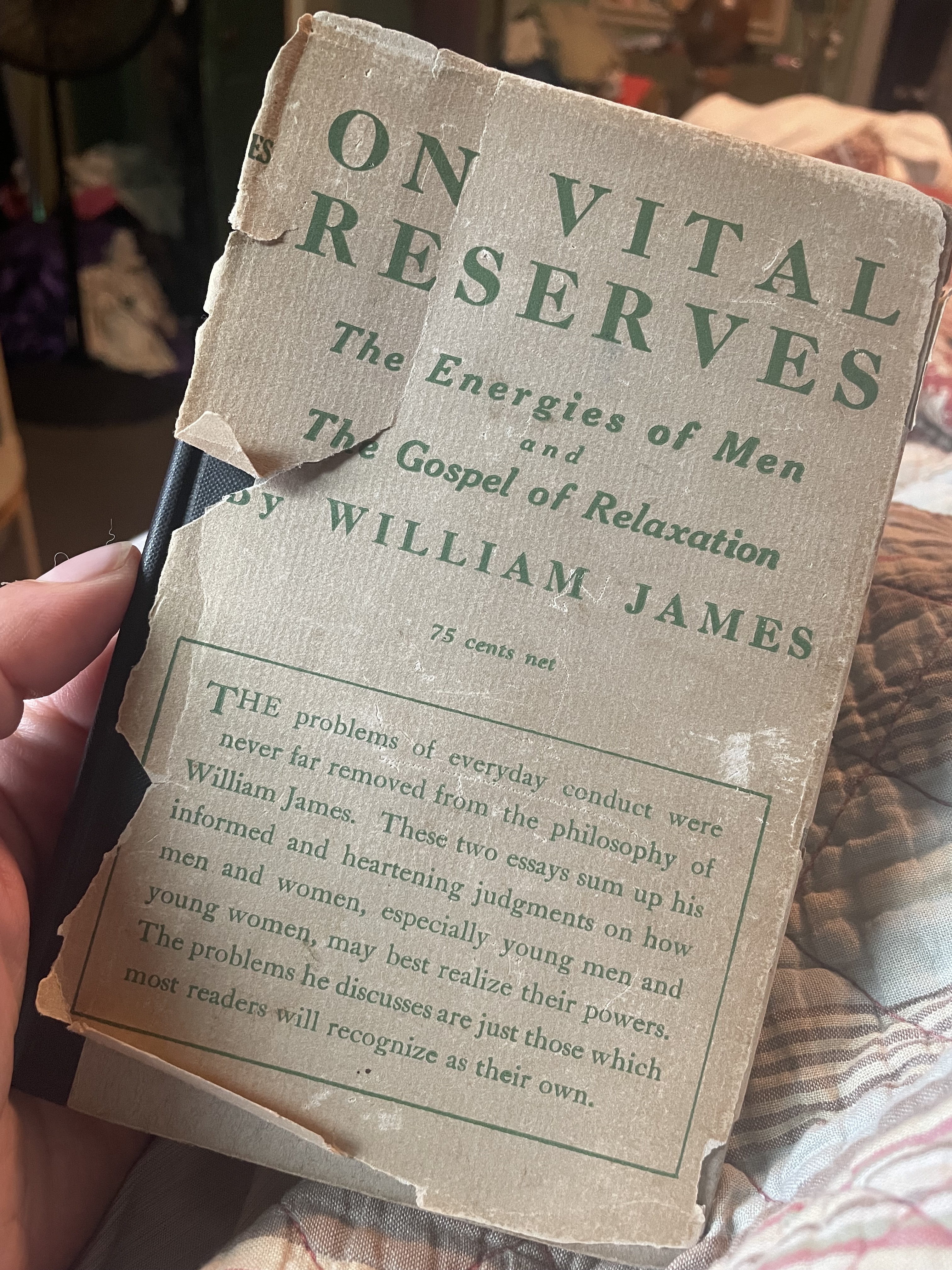
I found this little book at an antique shop that contained two essays by William James, one of the founders of American psychology. It was published in 1899 and cost 75cents in the 1922 reprint. I paid $15. That’s the inflation rate on antique philosophical little books that you can read by the lake for leisure in the summer.
The second of the two essays in the book is called The Gospel of Relaxation he makes a point quite in opposition to our current American culture. He writes, “…our emotions are mainly due to those organic stirrings that are aroused in us in a reflex way by the stimulus of the exciting object or situation. An emotion of fear, for example, or surprise, is not a direct effect of the object’s presence on the mind, but an effect of that still earlier effect, the bodily commotion which the object suddenly excites.” For example, “when we feel sorry it is because we weep, when we feel afraid it is because we run away, and not conversely.”
It’s interesting because everyone in our culture is trying to be authentic. And by that we mean that we need to behave in accordance with our feelings. If we are behaving one way but feeling another, we are being hypocritical, so the current theory goes. This is at the root of even gender theories: you are what you feel you are.
However, this idea is the opposite. He says you feel the way you do because you behave the way you do. If you wish to be brave, do not run away. If you wish to be happy, force a smile. He continues, “Action seems to follow feeling, but really action and feeling go together; and by regulating the action, which is under the more direct control of the will, we can indirectly regulate the feeling, which is not. Thus the sovereign voluntary path to cheerfulness, if our spontaneous cheerfulness be lost, is to sit up cheerfully, to look around cheerfully, and to act and speak as if cheerfulness were already there.”
Now I’m not sure exactly how I feel about what he wrote, because perhaps no one can power of positive think their way out of something like grief. But as a daily guiding principle, I think it’s not too shabby. If I ever needed a philosophical excuse to romanticize my life, here it is. It calls to mind what Rilke wrote, “If your daily life seems poor, do not blame it; blame yourself, tell yourself that you are not poet enough to call forth its riches…”
If romanticizing my life is wrong, I don’t want to be right. I want to write while listening to the summer rain and sipping my coffee. Things are not perfect, but I shall act in such a way that every little thing is being weaved into something so beautiful. And it is true that when I look back I can see the image weaved, even if in the moment they appear like isolated strands that on their own don’t seem like that much.
Weaving
I love Mondays because my husband and I run errands together and eat breakfast or lunch at the kinds of joints that have the history of the place and the founders told on the backside of the menu. It’s perfect because there’s more food than fuss on the plate and I have such a crush on my dining companion.
I love breakfasts of all kinds though. The ones at diners and the ones at home. On weekdays I read to the children while they eat and then we discuss the reading…if they were paying attention. We pray the Morning Offering together.
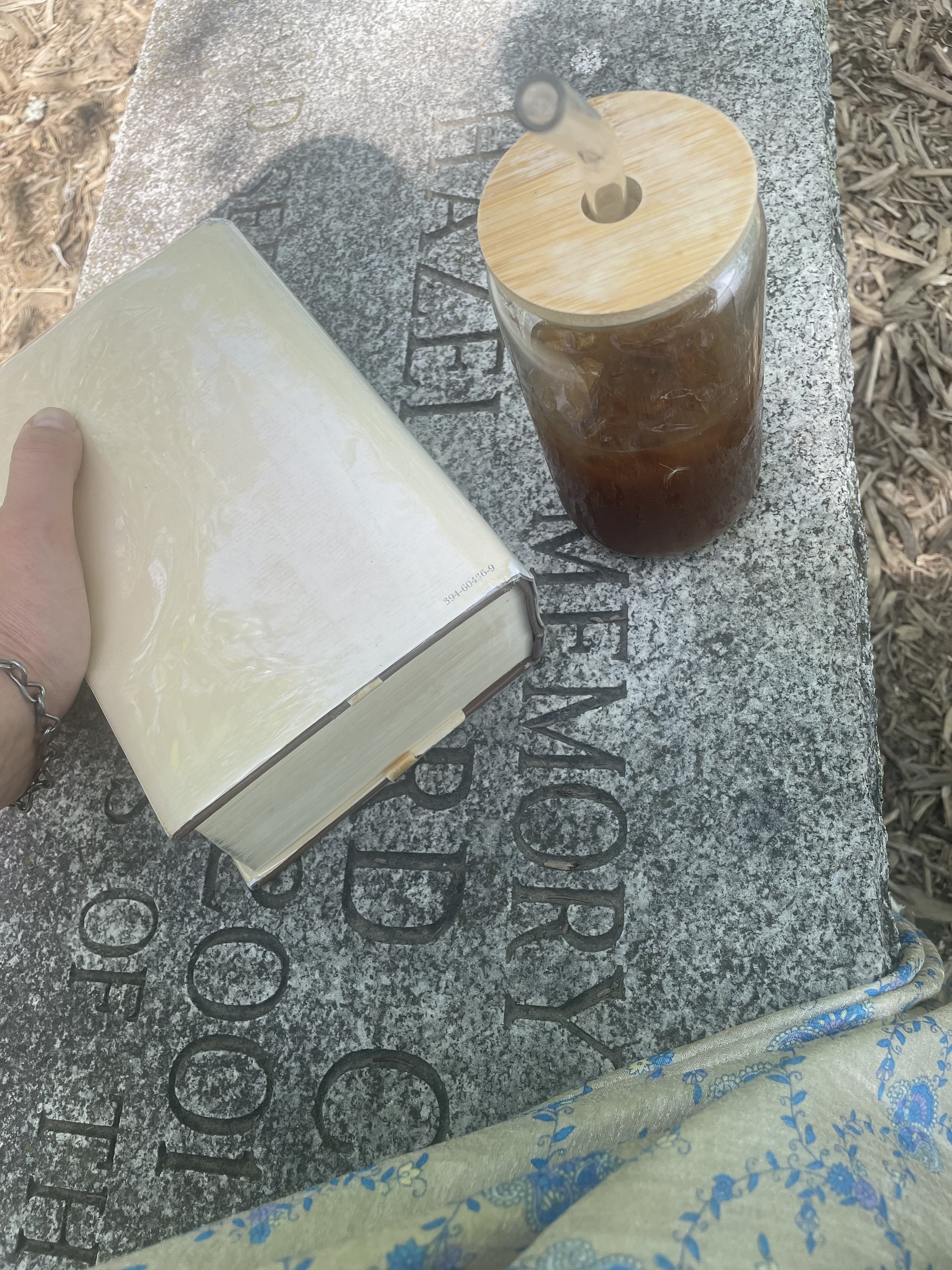
I love benches with inscriptions dedicated to the one who loved that view or garden or park. What a completely lovely thing to have someone build in your memory. It’s a memorial to rest and reflection. What a horrible thing to have something like a factory or appliance named after you. But a bench with a view of the lake where you watched the herons land or the children swim–that a memorial near eternal.

I love naps. Even if I am not sleepy, I’m always down to snuggle. There is just something about putting the world on pause and lying down in the middle of the day. It’s a 30 minutes act of holy rebellion to choose rest.
For someone almost always dehydrated, I love beverages. I love squeezes of limes and rim with spices and things that are mulled or chilled or that brew in the sun in a big jug for everyone to share. I love glassware that matches the drink, because a mule in a metal cup or a martini in a coup just feels right. I love coffee in mugs that match the vibe and tea in cups that rest on saucers. I think paper cups ruin the taste of most drinks and I hate that.
I love it when the dog plops down next to me lets out a big sigh as if she’s a single mom who works two jobs. I love it when she falls asleep on my foot.
Candles, music on vinyls, homemade blankets placed on the rocking chairs, watching the sunset with someone you love.
A stack of freshly folded towels and a bed with freshly laundered sheets.
Letters in the mail that are not bills or junk, texts that just say “I love you,” inside jokes, and outside voices.
Clove cigarettes and long conversations over a cigar and brandy. Late night prayers and early morning hymns.
I can romanticize all the things. And there is something very holy about that.
It’s Contagious
We all know what it’s like to be around that one person so full of nervous energy that everyone around them also becomes anxious. When mom refuses to sit down and rest, no one else in the house feels like they can rest either. Conversely, you can actually manifest peace. You can choose to be Mary or Martha. The stuff will get done anyway.

In this little book, William James writes, “If one’s example of easy and calm ways is to be effectively contagious, one feels by instinct that the less voluntarily one aims at getting imitated, the more unconscious one keeps in the matter, the more likely one is to succeed. Become the imitable thing, and you may then discharge your minds of all responsibility for the imitation. The laws of social nature will take care of that result.” He goes on to articulate something akin to detachment. Something like not giving-in to scrupulosity or stressing about whether we are enjoying life enough or relaxing enough. We cannot treat achieving peace as some sort of item on a to-do list. Rather, he says to “unclamp” your mind from the pressure and the outcome and to live and work for the love God and for the thing being done.
How refreshing is that?!
He ends the essay addressed particularly to women. He says, “What our girl-students and women-teachers most need nowadays is not the exacerbation, but rather the toning-down of their moral tensions. Even now I fear that some one of my fair hearers may be making an undying resolve to become strenuously relaxed, cost what it will, for the remainder of her life. It is needless to say that this is not the way to do it. The way to do it, paradoxical as it may seem, is genuinely not to care whether you are doing it or not. Then possibly, by the grace of God, you may all at once find that you are doing it, and, having learned what the trick feels like, you may (again by the grace of God) be enabled to go on. And that something like this may be the happy experience of all my hearers is, in closing, my most earnest wish.”