
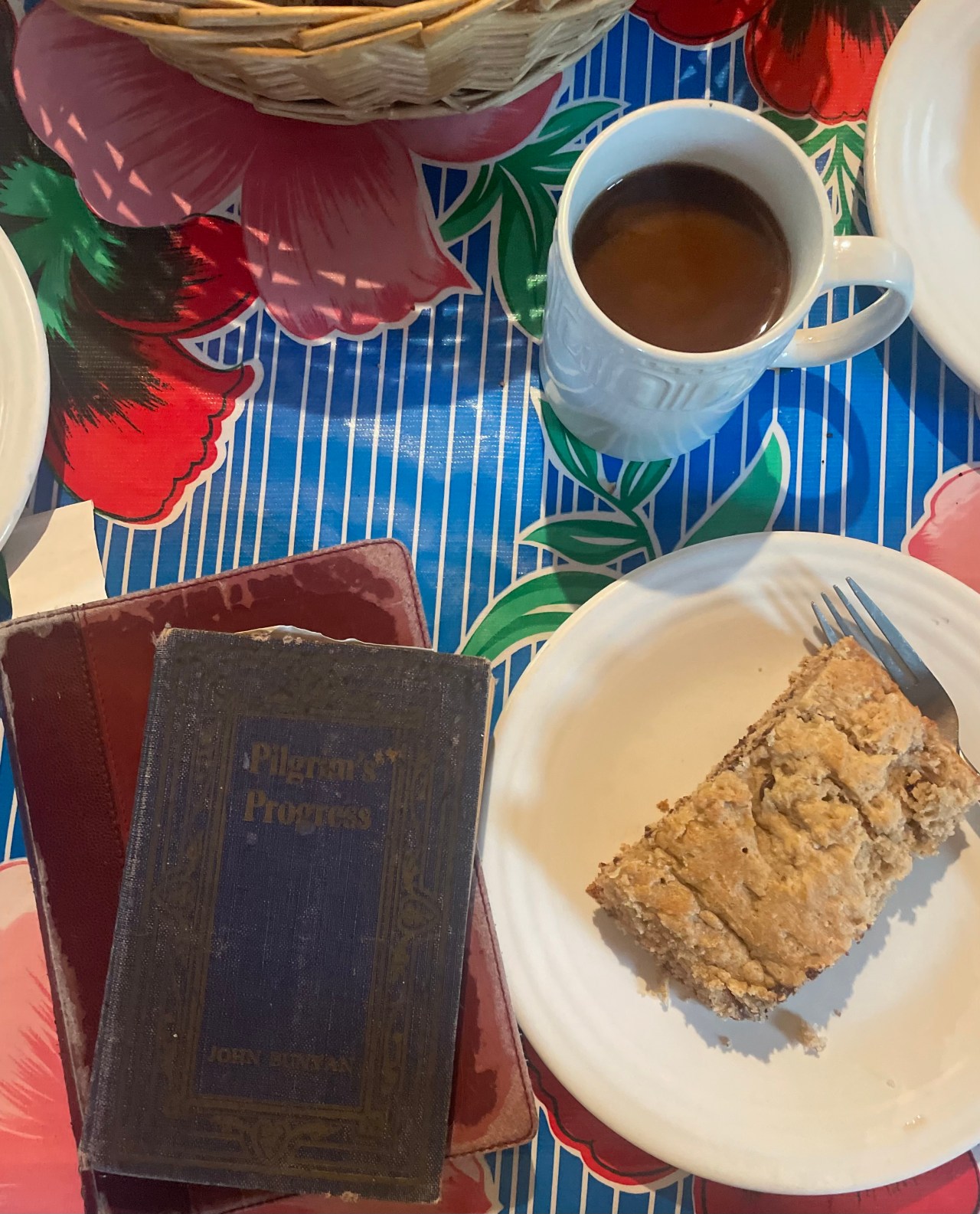
Today begins my 20th year homeschooling my children.This post is not self-congratulatory, a flex, nor a how-to. I have no hacks, no shortcuts, or magic bullets. What I have are 20 years of loving my children through striving to form their minds and hearts. In doing so, I’ve formed my own soul. I’ve participated a bit in working out my own salvation with fear and trembling. (Philippians 2:12)
Gratia non tollit naturam, sed perficit
Today at breakfast we talked about how St. Albert the Great said “Grace builds on nature.”
St. Thomas Aquinas says it this way, “Gratia non tollit naturam, sed perficit.” Grace does not destroy nature, but perfects it.
We further discussed how we could give grace a better foundation on which to build. What do we read, watch, consume? Are we disciplined? Do we do hard work? Do we serve others? It was a fruitful conversation and it made me think of my mother’s homeschooling philosophy.
You see, I was one of the OG homeschoolers in the 80s. When my parents’ started homeschooling us we didn’t know any other homeschoolers. It was just my siblings and me…and our parents’ relentless rebellion against society. I’m honestly not sure if in the beginning the appeal was so much doing school at home as it was being contrarian to the general culture. My folks were already home birth hippies, why not add homeschooling to that list of fearless independence.
About a year into homeschooling, my family fell on hard times. Those are stories for the Tell-All. Suffice it to say we could not afford curriculum, school supplies, new books, nor field trips. In fact, for a period of that school year we were homeless. My parents were faced with the choice of whether they would continue homeschooling us according to their convictions or if they would enroll us in the local public school. My mom tells it this way: she prayed. And God said, “You take care of their hands and their hearts, and I will take care of their heads.”
So, we worked. And we read. And we listened to music. And we prayed.
Our whole school year essentially consisted of us going to the library several times a week, reading everything we could get our hands on, and listening to classical music checked out from the library. As a homeschooling mother myself, looking back, I bet my mom was sweating through that year. We didn’t have curriculum like other kids or very many opportunities at all. But the library was there. The music was there. And the family was there praying together.
At the end of the school year we took the obligatory standardized tests in the State of California. We had advanced in every category, including subjects she had not taught us. We were all reading at a high school or college level. Thus began my mother’s homeschooling philosophy that focused on moral character and hard work. The academics took a back seat.
There Is No Formula
One thing led to another and I became the homeschooler who homeschooled. I really never considered doing otherwise. While I do not do things exactly the way my parents did, I have retained my commitment to teach my children myself and to curate their education according to my values. Today we began year 20. I have homeschooled:
- as a stay-at-home mom
- working full-time outside the home
- as a married woman
- as a single mom
- when we had money for curriculum and experiences
- when we could barely making ends meet, living on food stamps and fumes
- when I’ve been healthy and full of energy
- when I’ve been bedridden and dying
- with a co-op for support
- all by myself in the big-wide-world
- when we lived close to family for support
- when we lived 3,000 miles from family
So I can tell you with certainty that there is no formula for homeschooling. There is no one right way to do it. There is no magic bullet that will guarantee that your children turn out pious, smart, motivated, or upwardly mobile. There is mostly just grace, building on nature. However you choose to homeschool (and there are as many ways as there are children) the main thing is that you set the table of learning with resources, love, time, and tenderness. You have to give room for grace to build on nature.
This is my only homeschooling advice: If you choose to undertake this, leave room for grace. Let grace do the heavy lifting, or building as it were.
So far so good, I think. I’ve graduated six. Three more to go. Among the graduated I have an office administrator and chef, a graduate student in psychology, a builder and foreman, a student majoring in politics and interning in Washington DC, a fire fighter and stone finisher, and natural food grocer. Their chosen fields are as different as they are. Although all raised in the same home, their educations were different–according to their goals, their gifts, their abilities. To adjust your schooling accordingly takes an intimacy with your child. Are you paying attention? Are you loving them in all their stages? Are you finding where the spark of their imagination is lit and pouring some kerosene on it? Slow down, Mama. Slow way down and watch them closely. Then love them well.
Kahlil Gibran writes,
"And a woman who held a babe against her bosom said, Speak to us of Children.
And he said:
Your children are not your children.
They are the sons and daughters of Life's longing for itself.
They come through you but not from you,
And though they are with you yet they belong not to you.

You may give them your love but not your thoughts,
For they have their own thoughts.
You may house their bodies but not their souls,
For their souls dwell in the house of tomorrow, which you cannot visit, not even in your dreams.
You may strive to be like them, but seek not to make them like you.
For life goes not backward nor tarries with yesterday.
You are the bows from which your children as living arrows are sent forth.
The archer sees the mark upon the path of the infinite, and he bends you with His might that His arrows may go swift and far.
Let your bending in the Archer's hand be for gladness;
For even as He loves the arrows that flies, so He loves also the bow that is stable."


For real tho, congratulations. That is a huge deal to have homeschooled for 20 years. I graduated from homeschool. My mom homeschooled for 30+ years. Its a huge deal.
LikeLike
I still have about 7 years to go. Wonder what I’ll do with myself then! 🙂 Thanks for stopping by and thanks for commenting!
LikeLike
Lol! Keep younger homeschooling moms going? I have probably more than 25 years left lol! You’re welcome!!
LikeLike